Flowers Foods v. Brock
Petitioner Flowers Foods, Inc., et al. · Respondent Angelo Brock
- From
- United States Court of Appeals for the Tenth Circuit
- How it got here
- writ of <i>certiorari</i>
Are workers who deliver locally goods that travel in interstate commerce—but who do not transport the goods across borders nor interact with vehicles that cross borders—“transportation workers” “engaged in foreign or interstate commerce” for purposes of the exemption in Section 1 of the Federal Arbitration Act?
Question before the CourtWhat happened
Petitioners—the defendants, collectively known as “Flowers”—produce and sell packaged baked goods throughout the United States. Flowers utilizes a “direct-store-delivery” system, contracting with individuals it classifies as independent distributors who purchase the rights to distribute its products within specific geographic territories. In 2016, Angelo Brock, operating as Brock, Inc., signed a “Distributor Agreement” with Flowers Baking Co. of Denver, LLC (“Flowers Denver”) to distribute products in parts of Colorado. This agreement, along with a “Personal Guaranty” Brock signed, included a mandatory Arbitration Agreement stipulating that disputes must be resolved under the Federal Arbitration Act (FAA). Under this arrangement, Brock, Inc. placed orders for products, most of which were produced by Flowers bakeries located out of state, specifically to fill those orders. Flowers shipped the goods to a warehouse in Denver. Brock picked up the products at the warehouse, loaded them onto his own vehicle, and delivered them to his customers—various retail stores located only within Colorado. Brock himself did not cross state lines while making these deliveries. The business relationship soured, and Brock filed a lawsuit alleging Flowers misclassified its distributors as independent contractors to systematically underpay them, asserting violations of the Fair Labor Standards Act and Colorado labor law. Brock filed his putative class and collective action in the U.S. District Court for the District of Colorado. Flowers moved to compel arbitration based on the parties’ agreement, but the district court denied the motion, concluding that Brock falls within the FAA’s § 1 exemption for transportation workers engaged in interstate commerce. On appeal, the U.S. Court of Appeals for the Tenth Circuit affirmed that decision.
Unanimous.
All nine justices agreed on the outcome. Concurrences may differ on reasoning, but the Court spoke with one voice on the judgment.
The opinions 1
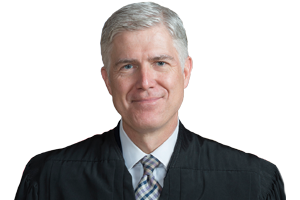
Neil Gorsuch
Joined by Roberts, Thomas, Alito, Sotomayor, Kagan, Barrett, Kavanaugh, and Jackson.
The holding
A worker who handles goods on a purely intrastate (within one state) leg of a broader interstate journey qualifies for the Federal Arbitration Act's (FAA) §1 exemption — meaning courts cannot force that worker into arbitration — even if the worker never personally crosses state lines or loads and unloads vehicles that do. Justice Neil Gorsuch authored the unanimous opinion of the Court. The FAA generally requires courts to enforce private arbitration agreements, but §1 carves out an exception for "contracts of employment" of workers "engaged in interstate commerce." The plain meaning of those words, drawn from dictionaries in use when Congress enacted the FAA in 1925, resolves the question. To "engage" meant to take part in, be employed in, or be involved in something. "Interstate commerce" meant the transportation of goods between points in one state and points in another — a definition that inherently includes intrastate stretches of a longer cross-border trip. A continuous delivery that begins in one state and ends in another is interstate commerce the entire way, even along the segments that stay within a single state's borders. A worker who handles goods during any direct, active, and necessary segment of that journey therefore participates in interstate commerce, regardless of whether the worker personally crosses a state line. Historical precedent reinforces this reading. In The Daniel Ball (1871), a steamship operating entirely within Michigan still counted as "engaged in commerce between the States" because it carried goods destined for other states. That principle — that multiple independent actors can each participate in a single interstate transaction even if each one stays within one state — maps directly onto the FAA's language. Flowers Foods argued that only workers who physically cross state lines or handle vehicles that do qualify for the exemption, but that bright-line rule finds no support in the statutory text and would produce absurd results, exempting only the driver who briefly crosses a border while excluding every other driver who moved the same shipment before and after that crossing.
Argued by
- Traci L. Lovitt for the Petitioners
- Jennifer D. Bennett for the Respondent
Case path
- Oct 20, 2025 granted
- Mar 25, 2026 argued
- May 28, 2026 decided