Consumer Financial Protection Bureau v. Community Financial Services Association of America
Petitioner Consumer Financial Protection Bureau, et al. · Respondent Community Financial Services Association of America, Limited, et al.
- Reporter
- 601 U.S. ___ (2024)
- From
- United States Court of Appeals for the Fifth Circuit
- How it got here
- writ of <i>certiorari</i>
Does the funding scheme for the Consumer Financial Protection Bureau, which receives funding directly from the Federal Reserve, violate the Appropriations Clause of the Constitution?
Question before the CourtWhat happened
In response to the financial crisis around 2007, Congress passed the Dodd–Frank Wall Street Reform and Consumer Protection Act, which, among other things, authorized the creation of the Consumer Financial Protection Bureau (CFPB) as an independent agency within the Federal Reserve. The CFPB was tasked with writing and enforcing rules for financial institutions, examining financial institutions, monitoring and reporting on markets, and tracking consumer complaints. In 2017, the CFPB adopted a rule that prohibited lenders from further attempting to withdraw funds from borrowers’ bank accounts after two consecutive attempts failed for lack of funds. A group of lenders sued the CFPB over that rule, arguing that the agency’s funding scheme was unconstitutional. Instead of receiving money allocated to it each year by Congress, as most agencies do, the CFPB receives funding directly from the Federal Reserve, which collects fees from member banks. The district court concluded the funding scheme was not unconstitutional, but the U.S. Court of Appeals for the Fifth Circuit reversed.
Cross-aisle coalition.
The split did not track the usual ideological lines — justices from both wings landed on the same side.
The opinions 4

Clarence Thomas
Joined by Roberts, Sotomayor, Kavanaugh, and Barrett.
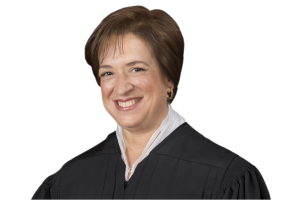
Elena Kagan
Joined by Roberts, Sotomayor, Kavanaugh, and Barrett.

Samuel A. Alito Jr.
Joined by Gorsuch.

Ketanji Brown Jackson
Joined by Roberts, Sotomayor, Kavanaugh, and Barrett.
The holding
The funding scheme for the Consumer Financial Protection Bureau satisfies the Appropriations Clause. Justice Clarence Thomas authored the 7-2 majority opinion of the Court. The Appropriations Clause provides that “[n]o Money shall be drawn from the Treasury, but in Consequence of Appropriations made by Law.” Art. I, §9, cl. 7—in other words, government spending must be authorized by an act of Congress. Historically, the word “appropriation” requires identifying a source of public funds and authorizing the expenditure of those funds for designated purposes. The practices of the English Parliament after the Glorious Revolution, the American Colonies, early state legislatures, and the First Congress varied widely in their specificity, duration, and structure, but all met these basic requirements. The statute authorizing the CFPB’s funding likewise contains the necessary elements of a valid appropriation under the Appropriations Clause. It identifies a source of funds (the combined earnings of the Federal Reserve System), sets a maximum amount that can be drawn, and specifies the purpose for which the funds can be used (to pay the CFPB’s expenses in carrying out its duties). Furthermore, the CFPB’s funding mechanism is analogous to some of the broad, open-ended appropriations passed by the First Congress. Therefore, the CFPB's funding statute satisfies the requirements of the Appropriations Clause. Justice Elena Kagan authored a concurring opinion, in which Justices Sonia Sotomayor, Brett Kavanaugh, and Amy Coney Barrett joined, noting that CFPB’s funding scheme would have been acceptable not only in the late-18th century, but also any other time in our Nation’s history. Justice Ketanji Brown Jackson authored a concurring opinion, endorsing judicial restraint. She pointed out that “when the Constitution’s text does not provide a limit to a coordinate branch’s power,” courts “should not lightly assume that Article III implicitly directs the Judiciary to find one.” Justice Samuel Alito authored a dissenting opinion, in which Justice Neil Gorsuch joined, arguing that the Appropriations Clause imposes more stringent obligations on Congress to monitor and control the expenditure of public funds and the projects they finance.
Argued by
- Elizabeth B. Prelogar for the Petitioners
- Noel J. Francisco for the Respondents
Case path
- Feb 27, 2023 granted
- Oct 3, 2023 argued
- May 16, 2024 decided