The Ohio Adjutant General’s Department v. Federal Labor Relations Authority
Petitioner The Ohio Adjutant General’s Department, et al. · Respondent Federal Labor Relations Authority, et al.
- Reporter
- 598 U.S. ___ (2023)
- From
- United States Court of Appeals for the Sixth Circuit
- How it got here
- writ of <i>certiorari</i>
Does the Civil Service Reform Act of 1978 empower the Federal Labor Relations Authority to regulate the labor practices of state militias?
Question before the CourtWhat happened
In 2016, the Ohio National Guard and its Adjutant General (the “Guard”) decided to end its 45-year-long relationship with the union that represents its technicians, who are civilian federal employees but are described as dual-status employees because of their hybrid civilian and military roles. As it was terminating the relationship, the Guard informed the union that it did not have Standard Form 1187s, which federal-sector bargaining-unit members are required to submit and which the Guard was obligated to maintain. The union filed four Unfair Labor Practice charges (ULPs) with the Federal Labor Relations Authority (FLRA). The FLRA’s regional general counsel investigated and found that the Guard had refused to negotiate in good faith. The Guard responded that it was not an “agency” and that the technicians were not “employees” within the meaning of the Federal Service Labor-Management Relations Statute. An administrative law judge (ALJ) disagreed, and a three-member FLRA panel adopted the ALJ’s recommended decision in full. The U.S. Court of Appeals for the Sixth Circuit denied the Guard’s petition for review, finding the FLRA has jurisdiction to adjudicate the collective-bargaining dispute.
Cross-aisle coalition.
The split did not track the usual ideological lines — justices from both wings landed on the same side.
The opinions 2
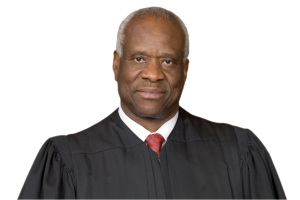
Clarence Thomas
Joined by Roberts, Sotomayor, Kagan, Kavanaugh, Barrett, and Jackson.
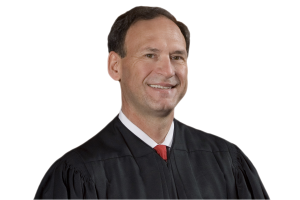
Samuel A. Alito Jr.
Joined by Gorsuch.
The holding
The Federal Labor Relations Authority (FLRA) had jurisdiction over this labor dispute because the state militia was acting as a federal agency when it hired and supervised dual-status technicians serving in their civilian roles. Justice Clarence Thomas authored the 7-2 majority opinion of the Court. Under the Federal Service Labor-Management Relations Statute (FSLMRS), the FLRA has jurisdiction only over labor organizations and federal agencies. The FSLMRS defines “agency” to include the Department of Defense. Dual-status technicians are defined by statute to be employees of the Department of the Air Force or Department of the Army—both of which are components of the Department of Defense and thus plainly within the jurisdiction of the FLRA. By hiring and supervising these employees, the Ohio National Guard and its Adjutant General were acting as a federal agency. Justice Samuel Alito filed a dissenting opinion, in which Justice Neil Gorsuch joined, arguing that while the Guard may act as a federal agency, exercise the authority of such an agency, and function as an agency, is not actually an agency and thus is outside the jurisdiction of the FLRA.
Argued by
- Benjamin M. Flowers for the Petitioners
- Nicole F. Reaves for the federal Respondent
- Andres M. Grajales for the union Respondent
Case path
- Oct 3, 2022 granted
- Jan 9, 2023 argued
- May 18, 2023 decided