Unicolors v. H&M Hennes & Mauritz, L.P.
Petitioner Unicolors, Inc. · Respondent H&M Hennes & Mauritz, L.P.
- Reporter
- 595 U.S. ___ (2022)
- From
- United States Court of Appeals for the Ninth Circuit
- How it got here
- writ of <i>certiorari</i>
Does 17 U.S.C. § 411 require a district court to request advice from the Copyright Office when there are questions about the validity of a copyright registration but no evidence of fraud or material error?
Question before the CourtWhat happened
Unicolors, Inc., a company that creates art designs for use on fabrics, created and copyrighted as part of a collection of designs a two-dimensional artwork called EH101 in 2011. In 2015, retail clothing store H&M began selling a jacket and skirt with an art design called “Xue Xu.” Unicolors sued H&M for copyright infringement, alleging that the Xue Xu design is identical to its EH101 design. The district court rejected H&M’s argument that Unicolors’ copyright was invalid because it had improperly used a single copyright registration to register 31 separate works. The court noted that invalidation of a copyright requires an intent to defraud, and no such evidence was presented in this case. Further, it concluded that the application contained no inaccuracies because the separate designs in the single registration were published on the same day. A jury returned a verdict for Unicolors, finding that it owned a valid copyright in EH101, that H&M had infringed on that copyright, and that the infringement was willful. On appeal, the U.S. Court of Appeals for the Ninth Circuit reversed, finding that there is no intent-to-defraud requirement for registration invalidation, and the district court failed to refer the matter to the Copyright Office, as required under 17 U.S.C. § 411(b)(2), when it was informed of inaccuracies in the copyright registration.
Cross-aisle coalition.
The split did not track the usual ideological lines — justices from both wings landed on the same side.
The opinions 2
Stephen G. Breyer
Joined by Roberts, Sotomayor, Kagan, Kavanaugh, and Barrett.
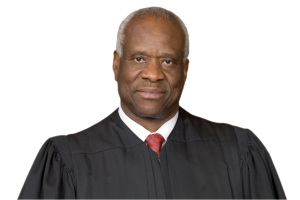
Clarence Thomas
Joined by Alito and Gorsuch.
The holding
Lack of either factual or legal knowledge can excuse an inaccuracy in a copyright registration under 17 U.S.C. § 411(b)(1)(A)’s safe harbor. Justice Stephen Breyer authored the 6-3 majority opinion. The Copyright Act safe harbor, 17 U.S.C. § 411(b)(1)(A) says that a certificate of registration is valid regardless of whether it contains inaccurate information unless the inaccurate information was included “with knowledge that it was inaccurate.” The statutory language makes no distinction between lack of legal knowledge or lack of factual knowledge. The U.S. Court of Appeals thus erred in holding that a copyright holder cannot benefit from the safe harbor if its lack of knowledge stems from a failure to understand the law. Justice Clarence Thomas filed a dissenting opinion, in which Justice Samuel Alito joined, and Justice Neil Gorsuch joined in part. Justice Thomas would dismiss the case as improvidently granted because the Court granted certiorari on a question of fraud but Unicolors put forth a different argument that the court below did not meaningfully consider.
Argued by
- E. Joshua Rosenkranz for the Petitioner
- Melissa N. Patterson for the United States, as amicus curiae, supporting the Petitioner
- Peter K. Stris for the Respondent
Case path
- Jun 1, 2021 granted
- Nov 8, 2021 argued
- Feb 24, 2022 decided