Tanzin v. Tanvir
Petitioner FNU Tanzin, et al. · Respondent Muhammad Tanvir, et al.
- Reporter
- 592 U.S. ___ (2020)
- From
- United States Court of Appeals for the Second Circuit
- How it got here
- writ of <i>certiorari</i>
Does the Religious Freedom Restoration Act of 1993, 42 U.S.C. § 2000bb, permit lawsuits seeking money damages against individual federal employees?
Question before the CourtWhat happened
The plaintiffs, Muslim men born outside of the U.S. but living lawfully inside the country, allege that the Federal Bureau of Investigation (FBI) placed their names on the national “No Fly List,” despite posing no threat to aviation, in retaliation for their refusal to become FBI informants reporting on fellow Muslims. They sued the agents in their official and individual capacities in U.S. federal court under the First Amendment, the Fifth Amendment, the Administrative Procedure Act, and the RFRA. They claim that the listing of their names substantially burdened their exercise of religion, in violation of the Religious Freedom Restoration Act (“RFRA”), because their refusal was compelled by Muslim tenets. Under RFRA, “[a] person whose religious exercise has been burdened in violation of this section may assert that violation as a claim or defense in a judicial proceeding and obtain appropriate relief against a government.” The U.S. District Court dismissed the claims against the agents in Appeals for the Second Circuit, a panel of which reversed the lower court. One of the agents, Tanzin, moved for rehearing en banc, which the court denied, over the dissent of several judges.
Unanimous.
All nine justices agreed on the outcome. Concurrences may differ on reasoning, but the Court spoke with one voice on the judgment.
The opinions 1
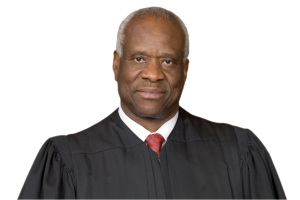
Clarence Thomas
Joined by Roberts, Breyer, Alito, Sotomayor, Kagan, Gorsuch, and Kavanaugh.
The holding
The express remedies of the Religious Freedom Restoration Act of 1993 (RFRA) permit litigants to obtain money damages against federal officials in their individual capacities. Justice Clarence Thomas delivered the opinion of the unanimous (8-0) Court. RFRA states that persons may sue and “obtain appropriate relief against a government,” including officials of the United States. In using this language, RFRA adopts a meaning of the word “government” different from its ordinary meaning—one that encompasses individual officials. The phrase “appropriate relief” is “open-ended,” and monetary damages have long been awarded as an appropriate form of relief. Thus, the best understanding of RFRA is that it permits lawsuits seeking money damages against individual federal officials. Justice Amy Coney Barrett took no part in the consideration or decision of this case.
Argued by
- Edwin S. Kneedler for the petitioners
- Ramzi Kassem for the respondents
Case path
- Nov 22, 2019 granted
- Oct 6, 2020 argued
- Dec 10, 2020 decided